Tao of Clay
Korean Wheel Throwing: Four-Day Workshop with Jason Han
Korean Wheel Throwing: Four-Day Workshop with Jason Han
Couldn't load pickup availability
$350 Per Person — Ages 18 and up
Ages 16–18 may participate with prior approval. Please contact info@taoofclay.com for more information.
Workshop Schedule
4 Days • 2 Weekends • 3 Hours Each Day
About This Course
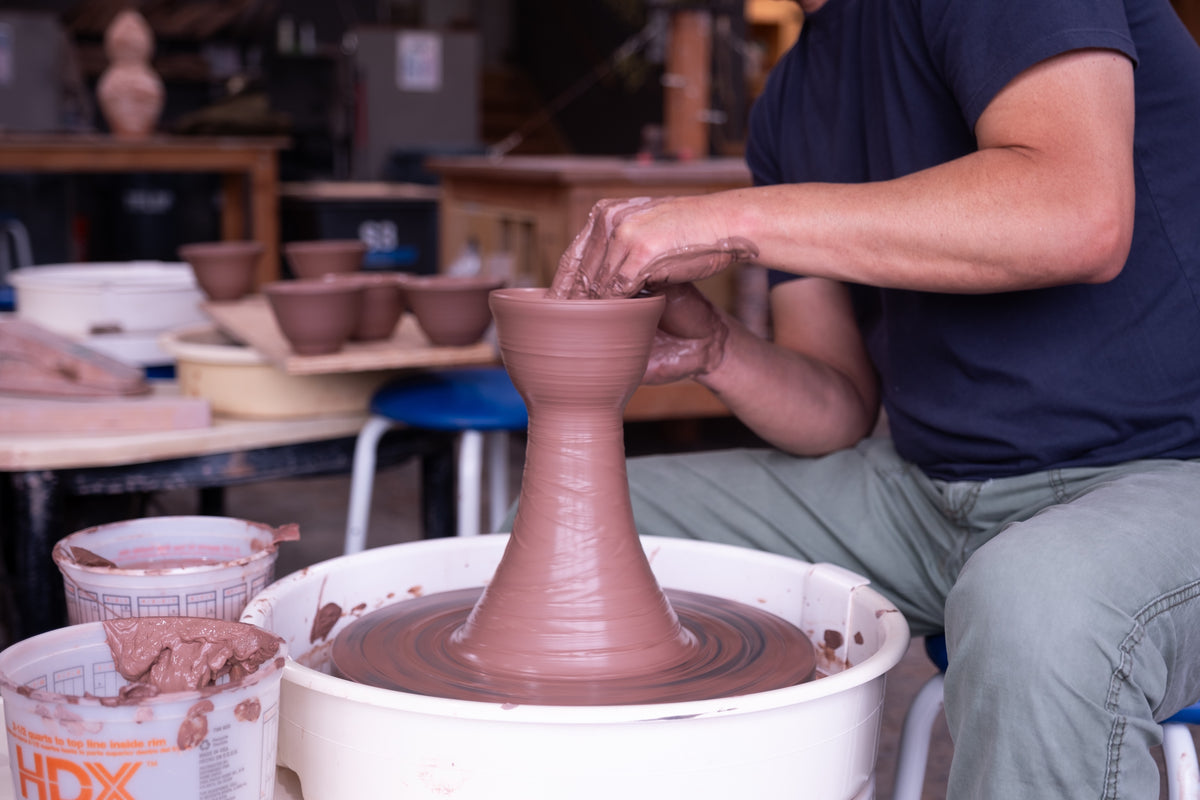
Explore the technique and rhythm of throwing off the hump, a method deeply rooted in Korean ceramic traditions. Rather than centering individual balls of clay, throwing off the hump allows you to work from one larger centered mass and create multiple forms with greater speed, efficiency, and directness.
In this four-day workshop, Jason Han of KRANE Pottery will introduce the techniques and principles behind this way of working, along with the history and cultural context that inform his approach.
Level: Beginner- Intermediate
Prerequisite Note: All levels are welcome. If you already center comfortably and can pull a cylinder you will be well prepared to move through this course.
What You’ll Learn
- Spiral wedging that helps clay center willingly.
- Throwing multiple forms from one centered mass.
- Sabal (Korean bowl), plates, vases, and larger forms as your confidence grows.
- Techniques for working efficiently and minimizing trimming.
- The history behind these methods and why they still matter today.
- A different rhythm at the wheel that encourages you to stop overworking and start trusting your hands.
More than simply learning another throwing technique, this workshop offers a different way of thinking at the wheel: working with the clay’s momentum, finding rhythm, and allowing your hands to become more direct and intuitive.
What to Bring
Tools & Materials: We provide clay, glaze, sponges, buckets, and storage for students enrolled in this class. Please note that throwing and trimming tools are not included—students are required to bring their own.
We recommend bringing a needle tool, wooden knife, your preferred throwing ribs, and trimming tools. A curated selection of our favorite tools, as well as beginner tool kits for throwing and hand-building, are available for purchase in our on-site shop.
Firing & Glazing
Firing is not included in the workshop fee. Firing is available through Tao of Clay at our standard rate of $5.00/lb. Finished pieces will be available for pickup approximately 2 weeks after firing.
Pieces over 14” in any dimension are subject to additional surcharge fees. Please contact info@taoofclay.com for more information about oversized work and pricing.
If you fire your work with Tao of Clay, you are welcome to return to the studio after the workshop dates during open hours to glaze your pieces.
Studio Access
As a student, you’ll have access to the studio outside of class hours to practice and develop your skills further!
*Please note: The studio is occasionally closed for events. Be sure to check our studio calendar online for any updates or closures affecting open hours.
We reserve the right to cancel the class due to low enrollment or for other necessary reasons.
Words from Jason Han of KRANE Pottery
Japan made pottery for more than ten thousand years without a potter's wheel.¹ When the wheel finally arrived, it came in Korean hands.
The Tokyo National Museum traces Japan's first stoneware—and its first wheel—to potters who crossed from Korea sixteen centuries ago.²
From there, East Asia developed two distinct ways of making pottery. In China's great porcelain centers, production became increasingly specialized. A Ming encyclopedist described a single piece of clay passing through “seventy-two hands” before it was finished.³
Korea followed a different path. Workshops had assistants and shared responsibilities, but the master potter remained responsible for the vessel itself—a tradition carried hand to hand through apprenticeship. A 1926 survey recorded potters at Korea's former royal kiln district averaging one hundred fifty small bowls in a single day—a bowl every few minutes.⁴⁵
That way of working is the focus of this workshop: throwing off the hump.
Not because Korea invented it, but because Korean potters made it unmistakably their own.
Fast. Direct. Expressive. One centered mass. Many pots. Each thrown for minimal trimming.
More than a production technique, it's a different rhythm at the wheel.
I teach this way because the rhythm helps you stop overworking and start trusting your hands.
For more than twenty-five years, I've maintained an active studio practice while studying Korean ceramic traditions. I've never thought of this work as perfecting a tradition. I've thought of it as remaining a lifelong student of one. What interests me isn't reproducing historical forms. It's understanding why these methods developed, what problems they solved, and how those same principles can remain useful for contemporary studio potters.
That's the perspective that shapes how I teach—and the invitation behind this workshop.
This isn't simply another throwing technique.
It's another way of thinking at the wheel.
Come throw with us.
Sources
1. Wu et al., Science (2012); Nakamura et al., Radiocarbon (2001).
2. Tokyo National Museum; The Metropolitan Museum of Art.
3. Song Yingxing, Tiangong Kaiwu (1637); UNESCO.
4. Sayers & Rinzler, The Korean Onggi Potter (1987); Cultural Heritage Administration of Korea.
5. 1926 Government-General industrial survey, as documented in Sayers & Rinzler (1987).
Cancellation Policy:
All sales are final and non-refundable. No refunds will be given for cancellations made at any time. Please consider this policy before purchasing a ticket.
Missed Class Policy:
We do not offer refunds, prorated refunds, or make-up sessions for missed workshop days or times.
Age Requirement:
Ages 18 + (Ages 16–18 may participate with prior approval. Please contact info@taoofclay.com for more information.)
Please contact info@taoofclay.com with any questions.